


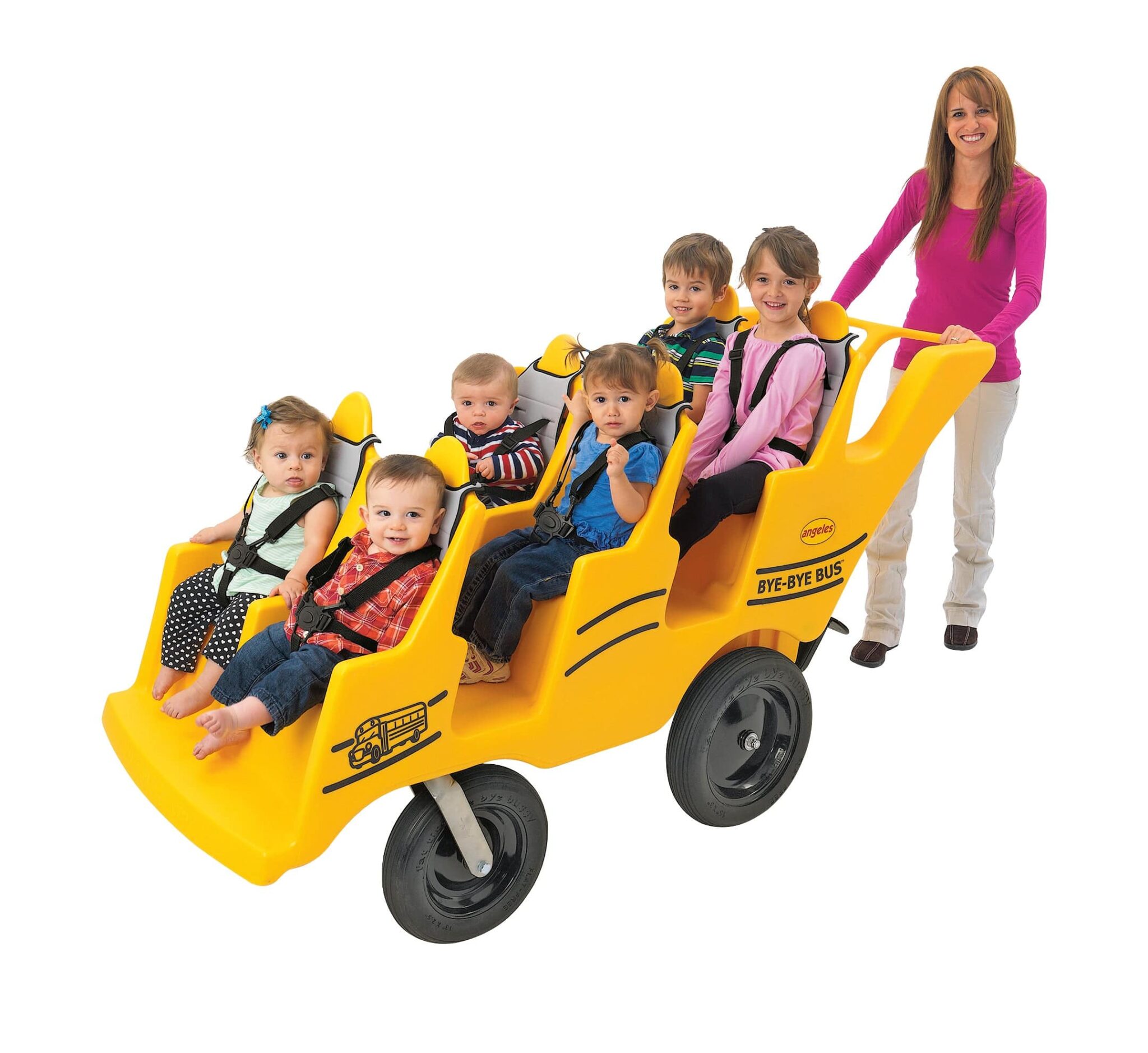
Taking a single infant or toddler outside is usually pretty simple. Strap them in the stroller, grab some snacks, and head out on an adventure. When you work at a daycare and want to take a group of infants or toddlers outside, the same concept applies: stroller, snacks, adventure time.
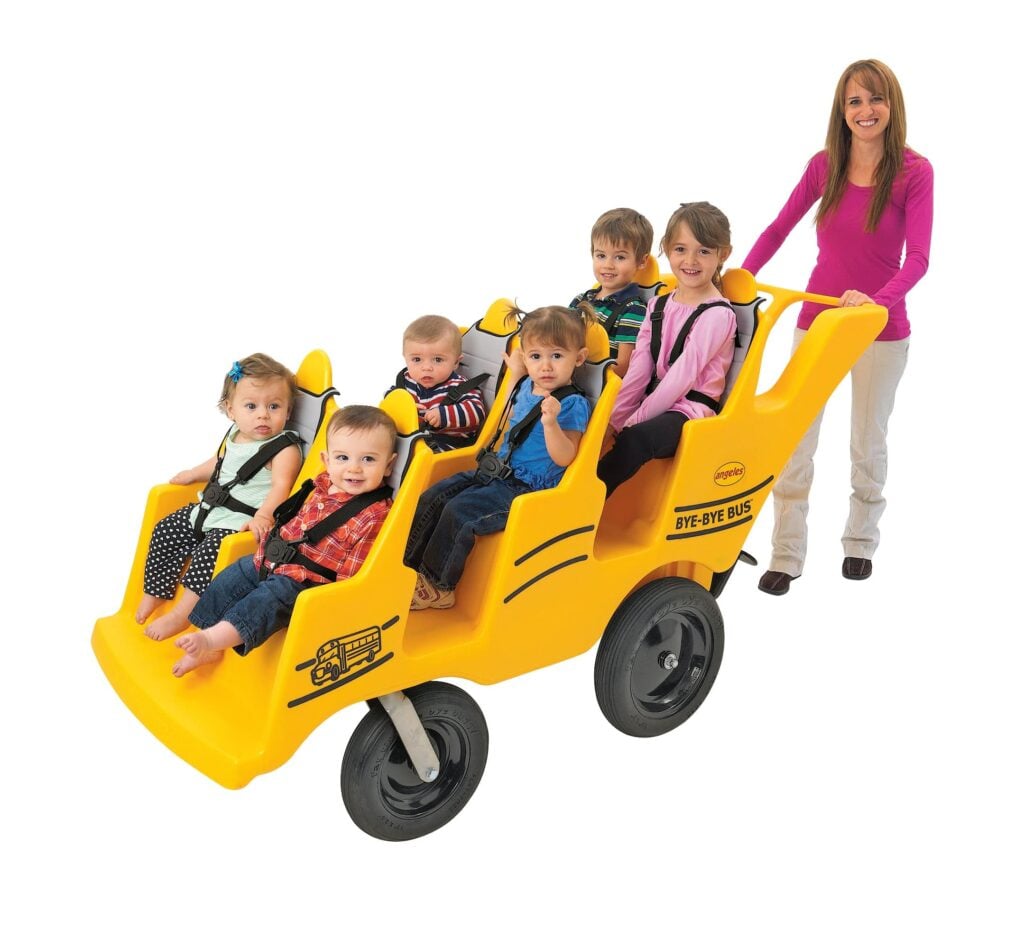
But unlike the strollers most parents use, daycare strollers may need to accommodate as many as four to six children at once. What’s more, the stroller needs to withstand heavy use and be easy to maneuver, yet easy to store without taking up too much space.
A daycare stroller or buggy is an investment in your staff, your families, and your facility. Here’s what to look for to help you get the most out of it.
Daycare strollers and daycare buggies serve the same basic purpose: transporting multiple children from point A to point B. While the terms are often used interchangeably, daycare strollers and daycare buggies can be quite different:
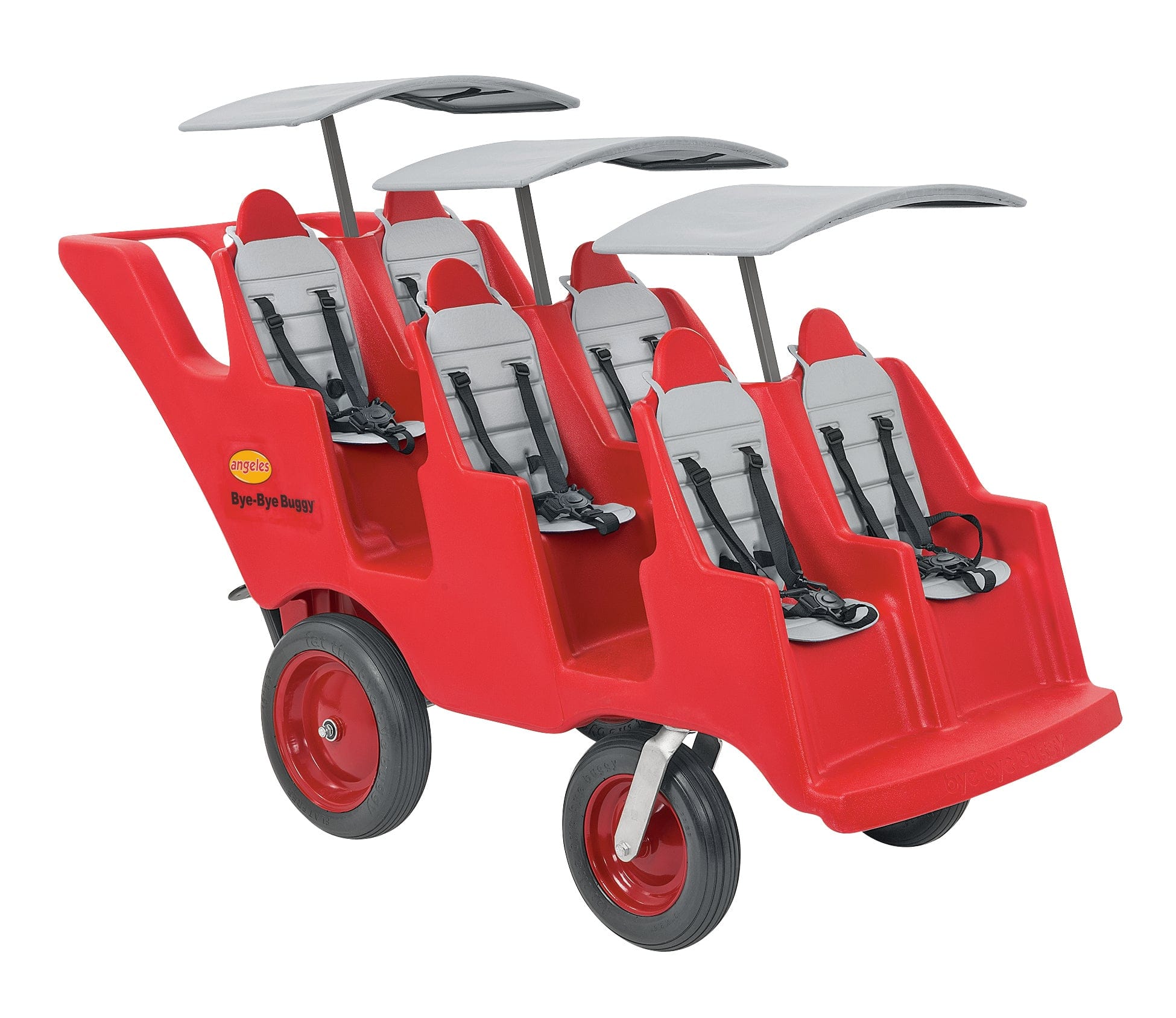
When choosing between a daycare stroller or buggy, the best place to start is thinking about where you’ll use it, how many children you’ll transport at one time, and the ages of those kids. These basics will help you narrow down the features that you’ll get the most use from and choose the right transportation for your facility.
Start by determining how many children will be in the buggy or stroller at the same time. For example, if your infant and toddler rooms regularly go on walks together, you may need a mix of seating options to accommodate each child’s ability (or inability) to sit independently and upright during the walk. Not all strollers and buggies offer reclining seats, but some have an insert similar to a car seat that lets an infant recline safely.
Every daycare stroller and buggy has weight or height limits. Manufacturers will usually tell you the maximum height a child should be for each seat or the maximum weight each seat can hold, not the overall capacity of the buggy or stroller. So, while a six-passenger buggy can transport more children in a single trip, depending on the size and weight of the children, it may be heavier than a four-passenger model. Two smaller strollers might be more practical and easy to maneuver than one large buggy.
Safety is a priority when choosing any stroller, but it’s especially important when you’re transporting multiple children. While you’re helping one with a misplaced sock or lost binky, you don’t want another one slipping out of their seat.
Some safety features to look out for include:
As a bonus safety feature, consider sun protection. Some daycare strollers and buggies come with a sun shade, while others offer it as an accessory. It’s a nice backup in case someone forgets their hat one day.

If you’ve ever pushed a single or double stroller, you know that maneuvering it can be challenging. Getting it through a swinging door by yourself isn’t always easy, and when only the front wheels swivel, the stroller may not end up exactly where you intended.
Now imagine doing the same with a daycare stroller or buggy full of kids!
So, as you’re comparing models, consider where and how you’re going to use it and what features might make steering easier.
Start by considering the surfaces you’ll travel over most often. Smooth sidewalks and paved paths are often easier to push a stroller or buggy over, compared to grass, gravel, or a rubberized playground surface.
Swiveling front wheels allow you to navigate corners and other tight turns, while fixed wheels make it easier to stay on the same straight path. Also consider how wide the wheels are. More occupants likely means wider wheels to accommodate the added weight, which could impact how easily or smoothly the stroller or buggy moves and turns.
But also look at whether the stroller or buggy has rubber or plastic wheels. Both will eventually wear down, but the advantage of plastic wheels is that it’s a lot harder to get a flat. However, many manufacturers offer run-flat tires, making it less likely you end up stranded at the park with a flat.
Finally, consider handle placement. Some buggies and strollers have a single bar that runs the length of the back end of the buggy, allowing you to adjust your grip and where you’re applying force, but not all do. Smaller models tend to have individual handles, similar to the stroller a parent would use.
When it comes to daycare strollers or buggies, size takes on a whole new meaning.
First, measure all the spaces it will pass through, like doors, hallways, or gates. Many daycare strollers and buggies are designed to fit through standard doorways, but that doesn’t mean every model will fit through your facility’s exterior and interior areas. Width isn’t the only size consideration, though. Longer strollers may be harder to turn in a hallway corner or maneuver in a smaller area.
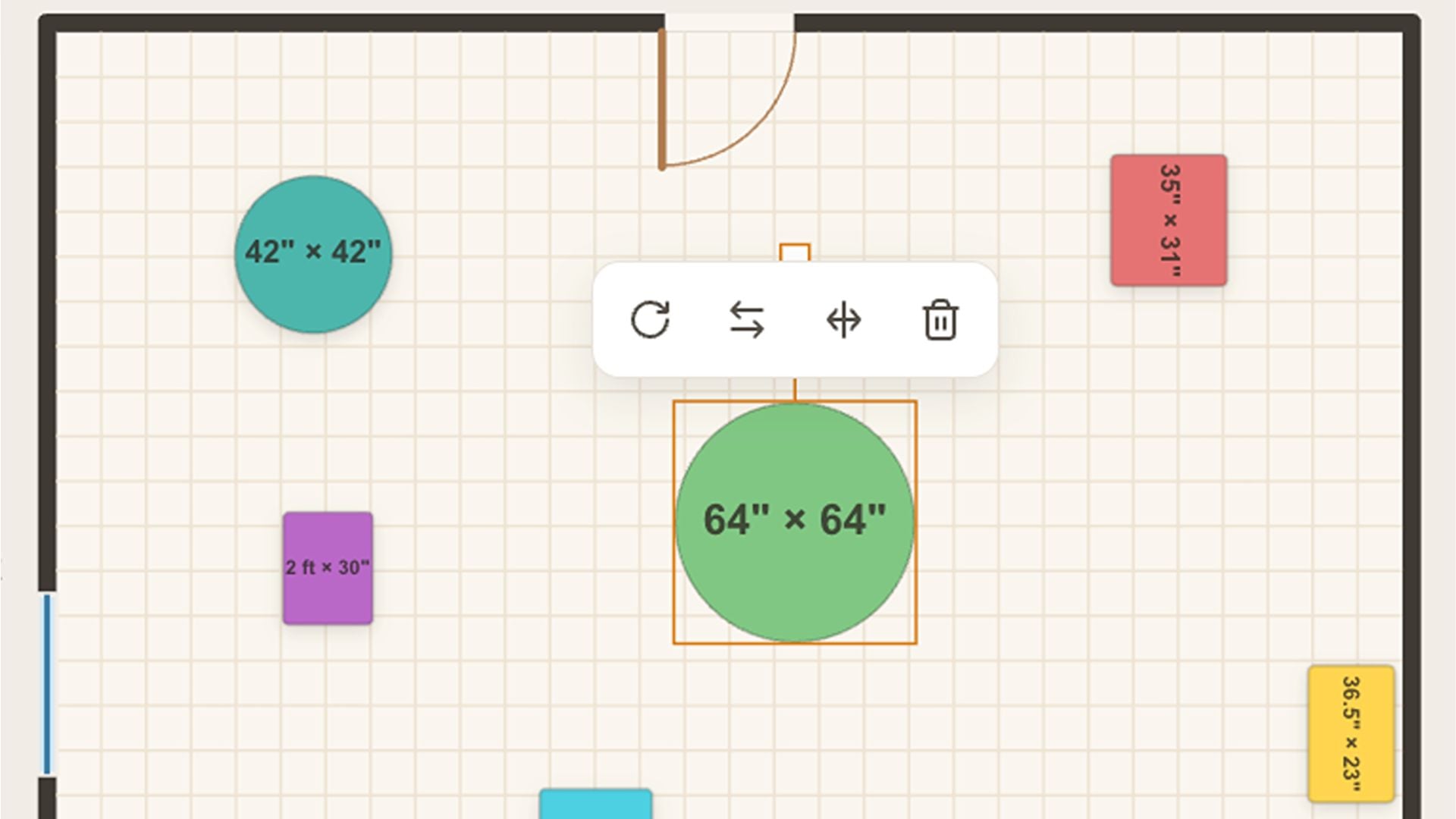
Second, measure the space you’ll store the stroller or buggy in. While folding strollers will likely need less space, a four-passenger stroller will still take up considerable room. Check the folded dimensions to make sure it fits into a closet or storage area safely.
A nonfolding buggy or stroller needs a dedicated storage location. That could be in the hallway, a classroom, or a designated parking area. If it’s the hallway, make sure the buggy or stroller doesn’t create a safety hazard in an emergency situation. And if you’re storing the buggy or stroller outside, consider getting a protective cover to minimize damage and wear from the elements.
Find the right place for your stroller or buggy
Daycare strollers and buggies are generally used several times a day, five times a week. It’s expected, but over time, the near-constant use can cause wear and tear on just about every part of your daycare stroller or buggy.
So, consider how often you think you’ll be cleaning your stroller and buggy, as well as the method you’ll use to clean it. Molded plastic seats have smooth surfaces that are relatively stain resistant as well as easy to wipe down and sanitize. At first glance, fabric seating may seem like the harder-to-care-for option. But depending on the fabric, it may be relatively stain resistant and easy to spot clean or even throw in the wash.
It’s also worth checking whether replacement parts are available. While a durable, well-made stroller should last a long time, see if you can get spare wheels, seat pads, or harnesses to have on hand just in case.
Daycare strollers and buggies are a significant investment. While the purchase price matters, it’s also worth considering warranty coverage and replacement part cost and availability. A less expensive stroller isn’t necessarily the better value if it only lasts a few years or frequently breaks down while you can’t get replacement parts or the warranty runs out after 30 days.
Even small daycare facilities will benefit from a daycare stroller or buggy. The ability to transport multiple children at one time as safely as possible ensures you’re providing an enriching and stimulating environment for every one of your charges.
At Kindermark Kids, our selection of daycare strollers and buggies is suitable for a wide range of early childhood settings. We have folding and nonfolding models that fit four to six passengers, as well as accessories to make your walk more pleasant.
Contact us today, and our knowledgeable staff will help you figure out which daycare stroller or buggy is the right fit for your situation. Or browse our full lineup of strollers, buggies, and accessories.